AI-Based Image Compression Using Genetic Algorithms
Oct 2025 – Dec 2025 · Brock University
Overview
This project formulates image compression as an optimization problem rather than relying on fixed interpolation methods. A block-based Genetic Algorithm (GA) is used to compress high-resolution RGB images (2000×1200) into compact 200×120 representations, which are later reconstructed through evolutionary optimization.
Challenges
- Extremely large search space due to pixel-level representation
- High computational cost of fitness evaluation
- Preserving global structure under a 100:1 compression ratio
- Block boundary artifacts during reconstruction
Actions Taken
- Designed a block-based GA to reduce optimization complexity
- Implemented pixel-level chromosome representation
- Used MSE-based fitness with upscaling reconstruction
- Applied selection, crossover, and mutation operators
- Compared results against nearest, bilinear, and bicubic baselines
Results
The GA-based approach consistently preserved global image structure and dominant color regions across object-focused, portrait, and natural scene images. Fine-grained texture was partially sacrificed, reflecting the aggressive compression ratio and computational limits.
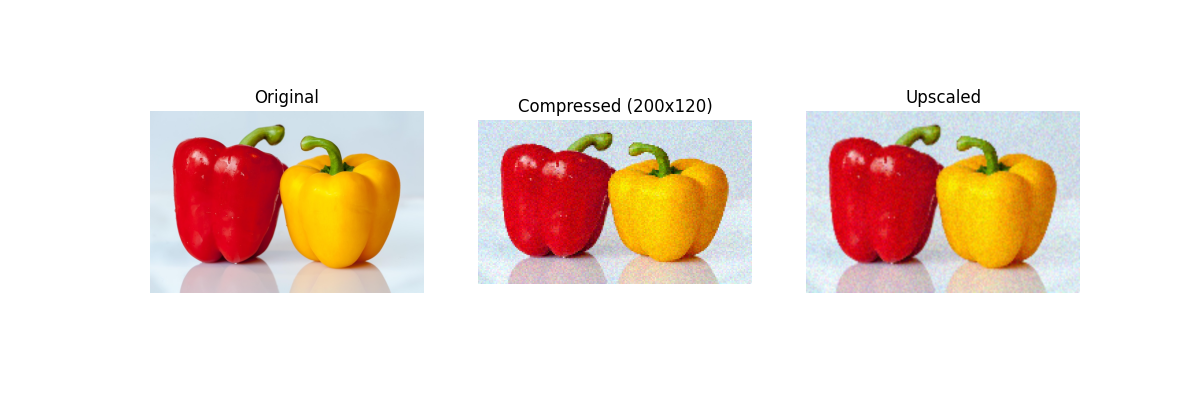
Object-based image: original, GA-compressed (200×120), reconstructed.

Portrait image: global facial structure preserved, fine details degraded.

Natural scene: large-scale structure retained, textures smoothed.
Evaluation Metrics
Performance was evaluated using Mean Squared Error (MSE), Peak Signal-to-Noise Ratio (PSNR), and Structural Similarity Index (SSIM), alongside visual inspection and baseline interpolation comparisons.